


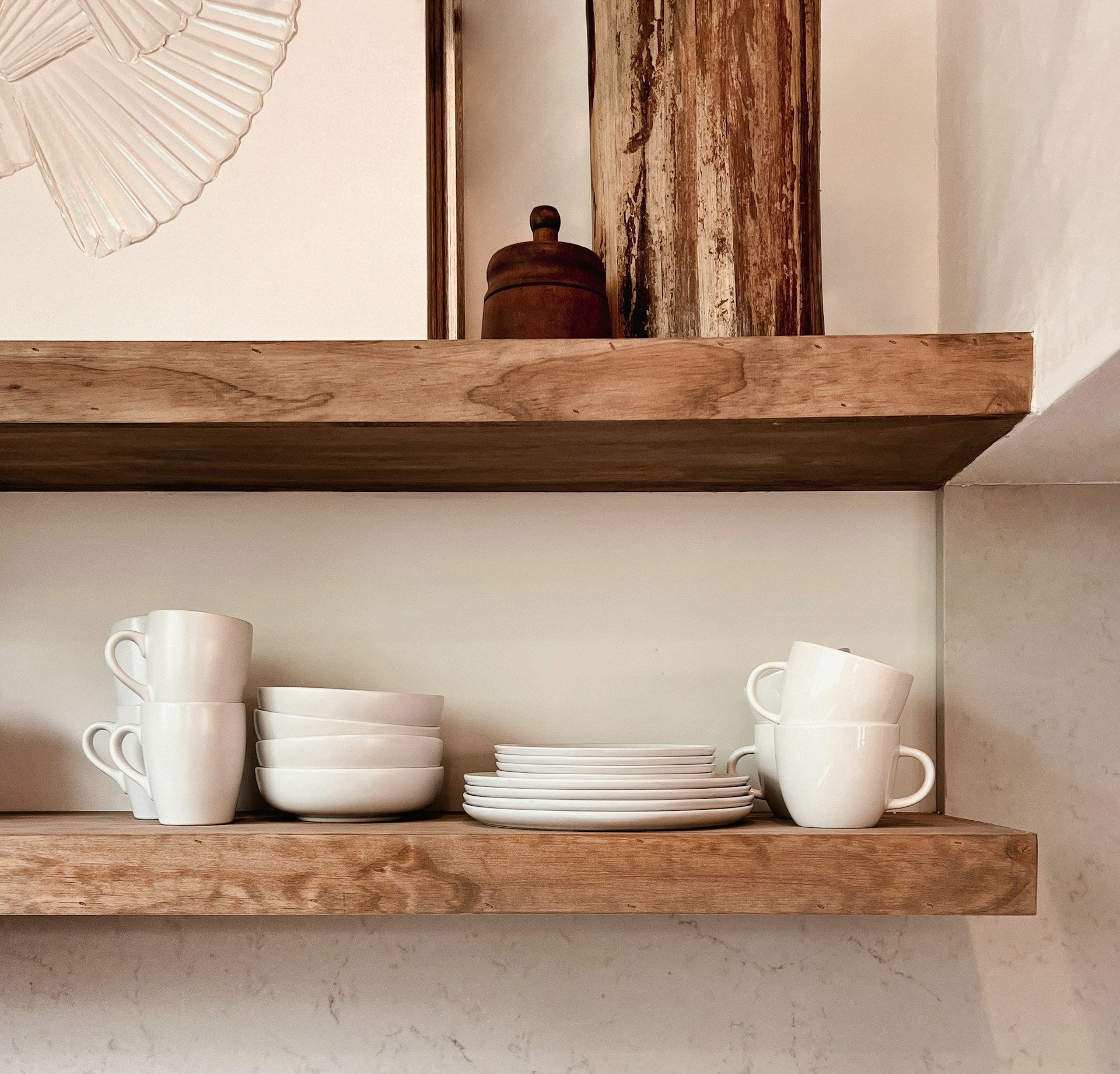
The Real Constraint: When Beautiful Shelves Start to Sag
Floating shelves are only beautiful if they stay straight. The moment a kitchen run starts to tilt under stoneware or a living room shelf creeps away from the wall under art books, the entire design reads as a failure. For architects, designers, and high-end homeowners, that is not just an aesthetic problem; it is a question of safety, liability, and long-term trust in the details you specify.
We treat floating shelves as structural components, not as decor. They carry loads from dense stoneware, books, barware, and daily use, sometimes with kids hanging or leaning on them. That is why we design our solid hardwood shelves around the Hovr Bracket System, Classic and Slim, and why we care so much about how wood, hardware, and wall structure work together. In this guide, we are going to talk about real numbers, real tolerances, and how to specify premium floating shelves in the USA with technical certainty instead of guesswork.
How Floating Shelves Actually Carry Load
When people talk about “load limits,” they are usually thinking about a single big object. Engineering looks at it a little differently. We care about how the shelf behaves under different types of load.
Key concepts that matter in real spaces include:
- Uniform load: weight spread along the length of the shelf, like a full run of plates or books.
- Point load: weight concentrated in one area, like a heavy Dutch oven or a stack of art books at one end.
- Static load: weight that stays put, such as styled decor.
- Dynamic load: weight that moves or gets bumped, such as kids tugging, placing items hard, or people using the shelf as a handhold.
Inside the wall and bracket, several forces are in play. The top of the bracket channel is in tension, the underside is in compression, and the fasteners that tie the bracket into the studs are in shear. Traditional two-prong rod brackets rely on relatively small rods cantilevered from a plate. Over time, rods flex, drywall compresses, and fasteners slowly creep. That is when “perfect” shelves start to slant.
The Hovr Male/Female Interlocking System solves this in a different way:
- The male aluminum profile mounts to the wall and can straddle multiple studs.
- The female aluminum profile is embedded accurately inside the shelf.
- A set screw locks both profiles together so there is no play, no wobble, and no slow slant.
Because Hovr uses 6063-T6 aircraft-grade aluminum in a continuous profile, the shelf behaves like a beam tied firmly to the stud structure, not like a few rods hanging out of the drywall. This is the structural backbone behind our heirloom wood shelving for architects who want documented performance, not optimistic marketing.
The Engineering Behind Hovr Floating Shelf Strength
The Hovr Classic bracket, paired with an 8-inch deep shelf, is rated for an average of 300 pounds of evenly distributed load per shelf. In practice, that gives you industry-leading strength, up to roughly 13 times stronger than many standard concealed brackets.
What does that actually mean in a home or commercial space?
- Full kitchen runs loaded with stoneware and everyday dishes stay level.
- Oversized art books or records can live on a single span without scary deflection.
- Dense bar setups with bottles, glassware, and shakers are safe.
- Busy households get a margin of safety if kids lean, pull, or use a shelf edge to steady themselves.
The continuous male profile makes an important difference. Because it straddles studs:
- You can secure into multiple studs even if they do not align with your exact layout.
- The load is shared across several fasteners, reducing stress on any single point.
- You avoid depending on a couple of anchors sitting in drywall alone.
Compared with common rod-based options, that means reduced flex, less long-term creep in the wall surface, and a cleaner, more predictable fit. For tight reveals, panel returns, and aligned grout lines, that consistency is what allows high-end detailing to read as intentional and permanent.
Our 1.75-Inch Profiles and Exact Hovr Integration
We settled on a 1.75-inch solid hardwood profile as the sweet spot where structural integrity and visual lightness meet. It reads lean and modern, but there is enough material to support real loads without feeling bulky.
Inside that 1.75-inch profile, the machining is where the engineering lives. In our studio, we run dedicated tooling for Hovr channels so that every shelf seats on the bracket the same way:
- Channel width is held within approximately 0.010 to 0.015 inches across the run. This keeps the female profile snug without binding, so there is no rattle or slop that could grow into sag.
- Channel depth is calibrated so there is a consistent wood “skin” beneath the aluminum, typically in the range of 0.187 to 0.250 inches. That leaves enough hardwood to stay strong, but not so much that it interferes with how the bracket seats.
- End-to-end length and squareness are held within about 0.010 inches over the shelf run, which keeps the male and female profiles fully engaged when the set screw is tightened.
We also pay close attention to grain direction and end grain management around the channel. Clean routing, no tear-out, and solid fibers beneath the aluminum matter, because voids or crushed fibers can compress over time. That is the difference between studio-built wood shelving for architects and mass-produced parts where hardware is “close enough” and performance varies shelf to shelf.
Specifying Load, Depth, Span, and Wall Type
Load limit is always a conversation between depth, span, and wall construction. Using the Hovr Classic at 8 inches as the reference point:
- Shallower shelves generally feel stiffer under the same load.
- Deeper shelves ask more of the bracket and the wall, especially with heavy objects near the front edge.
- Longer spans are possible when the bracket runs continuously and is tied into several studs.
For design professionals, a few practical guidelines help:
- Choose Hovr Classic for working shelves, such as open kitchen runs or bar walls that will be loaded daily.
- Choose Hovr Slim when the depth is modest, styling is light, and the design priority is a thinner visual line.
- Think about total wall load, not each shelf in isolation, especially when stacking multiple runs.
Wall structure matters as much as the shelf itself. To reach the published capacity, you want:
- Fasteners correctly sized for your studs and sheathing.
- The Hovr male profile catching as many studs as practical along the length.
- Alignment planned so the bracket lands where you want it relative to tile, paneling, or windows.
This is where pairing solid hardwood with the Hovr system pays off. You are not just picking premium floating shelves in the USA based on looks; you are specifying an engineered component that behaves predictably, project after project.
Material Choice, Finish, and Long-Term Stability
Under long-term load, material choice shows. Solid hardwood holds screws better than most composite cores and resists the slow creep that can cause edges to dip. Properly dried and milled stock, held in a 1.75-inch profile, stays true when it is actually asked to work.
When we select boards for heavily loaded shelves, we prioritize:
- Stable grain orientation, avoiding wild figure in high-stress spans.
- Clean, straight stock for long runs so the shelf stays flat over time.
- Smart end grain and joinery decisions on miters or extra-long units.
Finishes play a role too. We lean toward natural finishes or oiling options that protect the wood while allowing it to move seasonally without telegraphing small shifts. With White Oak, if a specific tone shift is desired, careful color work is important so high-use kitchen shelves age gracefully rather than looking patched or uneven.
When all of this is aligned, premium floating shelves in the USA can be both visually light and structurally serious. A well-built shelf on a properly installed Hovr bracket does not feel tentative when you load it. It feels like a permanent part of the architecture, which is exactly what it should be.
Upgrade Your Space With Lasting, Handcrafted Shelving
Transform your walls into functional, design-forward storage with our thoughtfully made Premium floating shelves in the USA. At The Mortise & The Hare, we carefully select hardwoods and finishes so your shelves look beautiful and perform reliably for years. If you have questions about sizing, load capacity, or custom options, reach out and contact us so we can help you plan the right setup for your home.
Share:
Eliminating Project Friction with Spec-Ready Floating Shelves
Vertical Engineering in the Spa Bath: Floating Shelves Over Toilets