


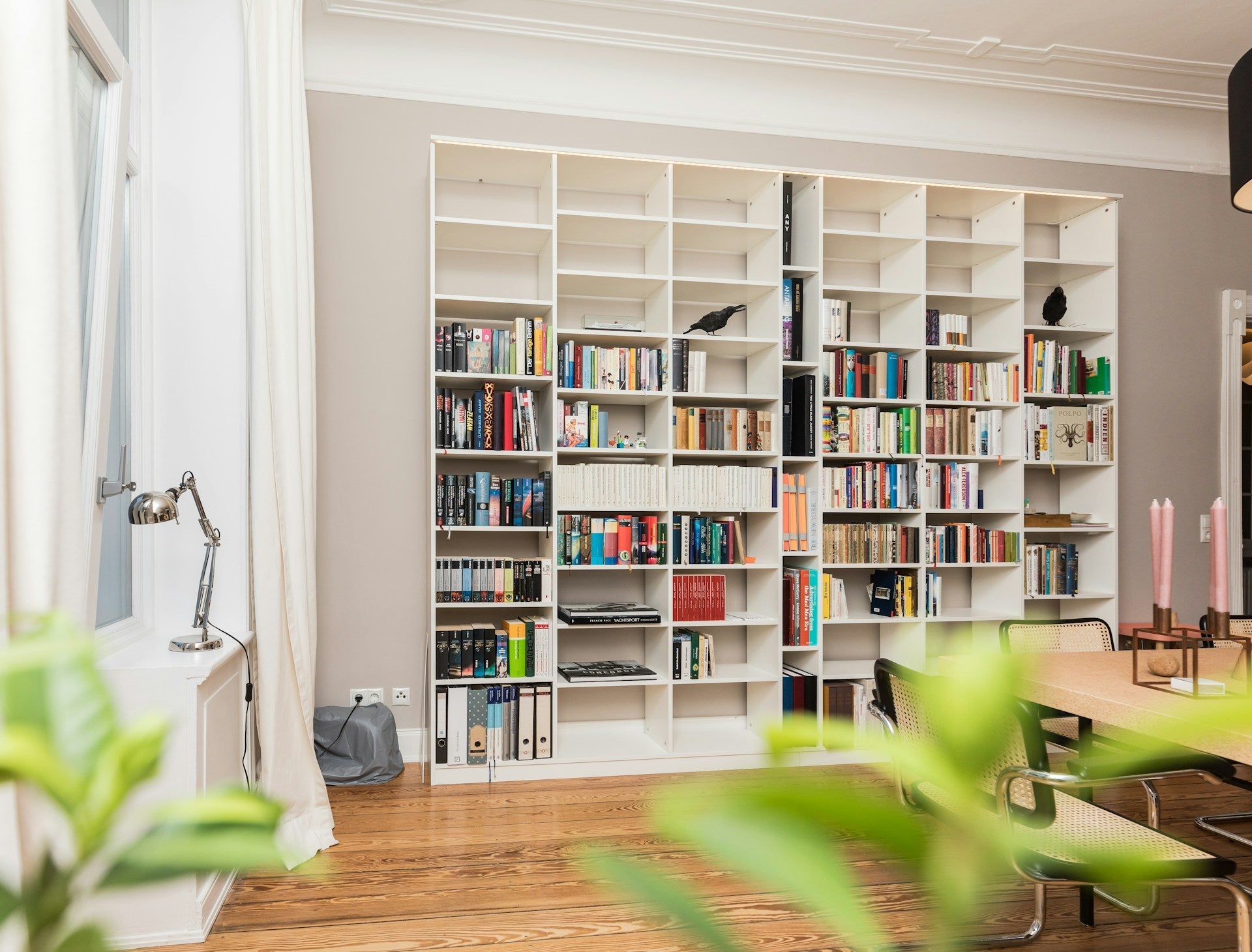
Why True Book Lovers Fear Floating Shelves
A serious book collection is heavy. Thick hardcovers, full runs of classic literature, art monographs, and vintage editions put real, relentless load on any shelf you trust with them. When you are building a home library wall, the quiet fear is not color palettes or styling, it is the future moment when those shelves start to sag.
Many of us know how that story goes. Big-box “floating” shelves with hollow cores and mystery screws look fine on day one, then slowly bow, tilt, or loosen at the wall as the years and new titles stack up. You start shifting books around, pulling the heaviest volumes off the worst offenders, and the whole wall stops feeling safe.
At The Mortise & The Hare, we approach open shelving differently. When we pair solid 1.75-inch hardwood shelves with a Hovr floating shelf bracket, we are not decorating a wall, we are building a structural element. The goal is simple: remove uncertainty, so a library wall feels permanent, predictable, and strong enough for a lifetime of serious reading.
What Makes a Library-Grade Floating Shelf
For a true library wall, material choice is the first line of defense against sagging. We work with solid hardwood, 1.75 inches thick, because that dimension gives you real screw-holding strength, stiffness, and long-term stability that MDF and particle board simply cannot match.
Solid hardwood matters for a few reasons in a high-load application like heavy book storage:
- Density that resists bending under continuous weight
- Strong fibers that hold fasteners securely over time
- Predictable movement with humidity, rather than sudden swelling or crumbling
- A surface that can be repaired and refreshed instead of thrown away
Inside the shop, how we treat the wood is just as important as what species you choose. We pay attention to grain orientation, end grain exposure, and the natural figure of each board so the shelf resists cupping or twisting under load. Stable grain patterns, carefully glued up, create a shelf that stays flat and true while packed with hardcovers.
Finish is another structural decision disguised as a design choice. For a working library, we favor hardwax oils like Rubio Monocoat or Osmo. They create a durable, tactile surface you actually want to touch, and if a book edge or mug leaves a mark, the finish can be spot-repaired without stripping an entire wall of shelving. When a client wants a darker look on White Oak, we treat that as its own process, because White Oak takes color differently than Walnut or Cherry and still needs to feel honest to the wood.
Within that framework, aesthetics stay wide open. A 1.75-inch profile in:
- White Oak works beautifully for Scandi, Japandi, or calm, minimal rooms
- Walnut brings warm, Mid-Century character with a low sheen
- Maple offers a light, clean canvas for modern spaces
- Cherry deepens gracefully over time for a classic library feel
The key is that design directions never come at the expense of strength. Thickness, species, and edge details are chosen to support both style and structure in equal measure.
Inside the Hovr Bracket: Hidden Strength for Heavy Books
The other half of a no-sag library wall is what you cannot see: the bracket. A Hovr floating shelf bracket in 6063-T6 aircraft-grade aluminum is a very different animal from two steel rods buried in the wall. Instead of two point loads, you get a continuous system designed to behave like part of the structure.
The Hovr Bracket System comes in Classic and Slim versions, both based on a male/female-interlocking system:
- The male bracket mounts to the wall and spans multiple studs
- The female bracket is embedded into the shelf itself
- The two parts slide together and lock with a set screw
- The result is a rigid connection that resists sagging and tilting
Because the bracket forms a continuous spine across the back of the shelf, load is spread across multiple fasteners and studs. That is where the “no-sag” performance comes from, in real terms, not marketing language. The Classic bracket at an 8-inch shelf depth is rated around 300 pounds per shelf, which is more than enough for dense, full-height book runs.
That strength is about safety as much as capacity. When you have kids who might pull on a shelf edge, stacks of oversized art books, or a library wall that spans an entire room, you want to know the hardware has industry-leading strength, not just that it looks clean in photos.
Solving the Practical Problems of a Permanent Library Wall
Even with the right wood and bracket, practical issues can derail a library project. Stud placement is a classic example. Studs rarely line up with where you actually want shelves to land.
Because the Hovr male bracket spans multiple studs, we can anchor securely wherever studs fall, then place 1.75-inch hardwood shelves exactly where the design calls for them. You are not forced to shift a shelf up or down a few inches just to catch a stud.
A typical installation sequence looks like this:
- Lay out shelf heights on the wall in pencil
- Locate studs and mark centerlines
- Choose appropriate structural screws for the wall type
- Mount the Hovr male bracket across as many studs as possible
- Rout and embed the female bracket in the back of each shelf
- Slide the shelf on and tighten the set screws for a rock-solid fit
Planning depth and spacing for books is the next step. For most home libraries, we see:
- 10 to 11 inches deep for standard novels and nonfiction
- 12 inches or a touch more for large-format art or design books
- Vertical spacing that leaves a comfortable finger gap above the tallest books
Because the system is engineered and repeatable, it is ideal for premium floating shelves in the USA where conditions vary. Different regions, different wall types, and the same predictable outcome: a shelf that stays level under real-world use, not just on install day.
Designing a Library That Feels Built-In, Not Bolted On
Strength solves the fear, but design makes the library feel like part of your home instead of an afterthought. We like to treat floating library shelves as architectural elements, not accessories.
A few guiding ideas we use when laying out a wall:
- Align shelf runs with window heads, door casing, or a fireplace mantel
- Carry continuous lines around corners where possible
- Use consistent reveals between shelves and adjacent trim
Material choices pull different styles out of the same structure. Warm, low-sheen Walnut pairs easily with Mid-Century furniture. Pale Maple or natural White Oak suits Scandi and Japandi spaces. Rift-cut White Oak creates ultra-clean, linear grain that works beautifully in minimalist rooms.
Visual weight matters too. A 1.75-inch-thick profile reads as confident and trustworthy, which aligns with the real load capacity hiding inside the wall. Thin, hollow shelves often trigger that little internal question, “Will that fall?” A thicker, solid hardwood shelf with the right bracket answers that question quietly every time you look at it.
Lighting and accessories finish the picture. Picture lights or discreet fixtures above the shelves can highlight spines without heating them. Leaving sections of open space for art or objects breaks up dense book runs and keeps the wall from feeling oppressive, while the load-bearing capacity of the bracket and hardwood does not change at all.
How Our Shelves Turn a Wall Into a Lifetime Library
When you combine solid hardwood at 1.75 inches thick with the Hovr Bracket System and its 13x stronger-than-standard brackets, you change what a floating shelf library can be. It stops being a styling experiment and becomes a permanent fixture that can carry a true collection, not just a handful of paperbacks and decor pieces.
At The Mortise & The Hare, we build for people who care as much about structure as they do about beauty. Board selection, grain orientation, joinery, and finish choices are all handled with the expectation that these shelves will be loaded, used, dusted, and lived with for decades. That is the certainty we want you to feel when you look at a bare wall and start planning your own home library: premium floating shelves in the USA that are genuinely ready for the weight of all the stories you own now, and all the ones you will collect in the years to come.
Upgrade Your Space With Custom-Crafted Floating Shelves
Bring your project to life with our handcrafted Premium floating shelves in the USA, carefully made to highlight your style and stand up to everyday use. At The Mortise & The Hare, we help you choose the right wood, finish, and dimensions so your shelving looks intentional in every room. If you are ready to talk details or need guidance on your layout, simply contact us and we will help you plan the perfect setup.
Share:
The Butler’s Pantry Equation for Rock-Solid Floating Shelves
Eliminating Project Friction with Spec-Ready Floating Shelves