


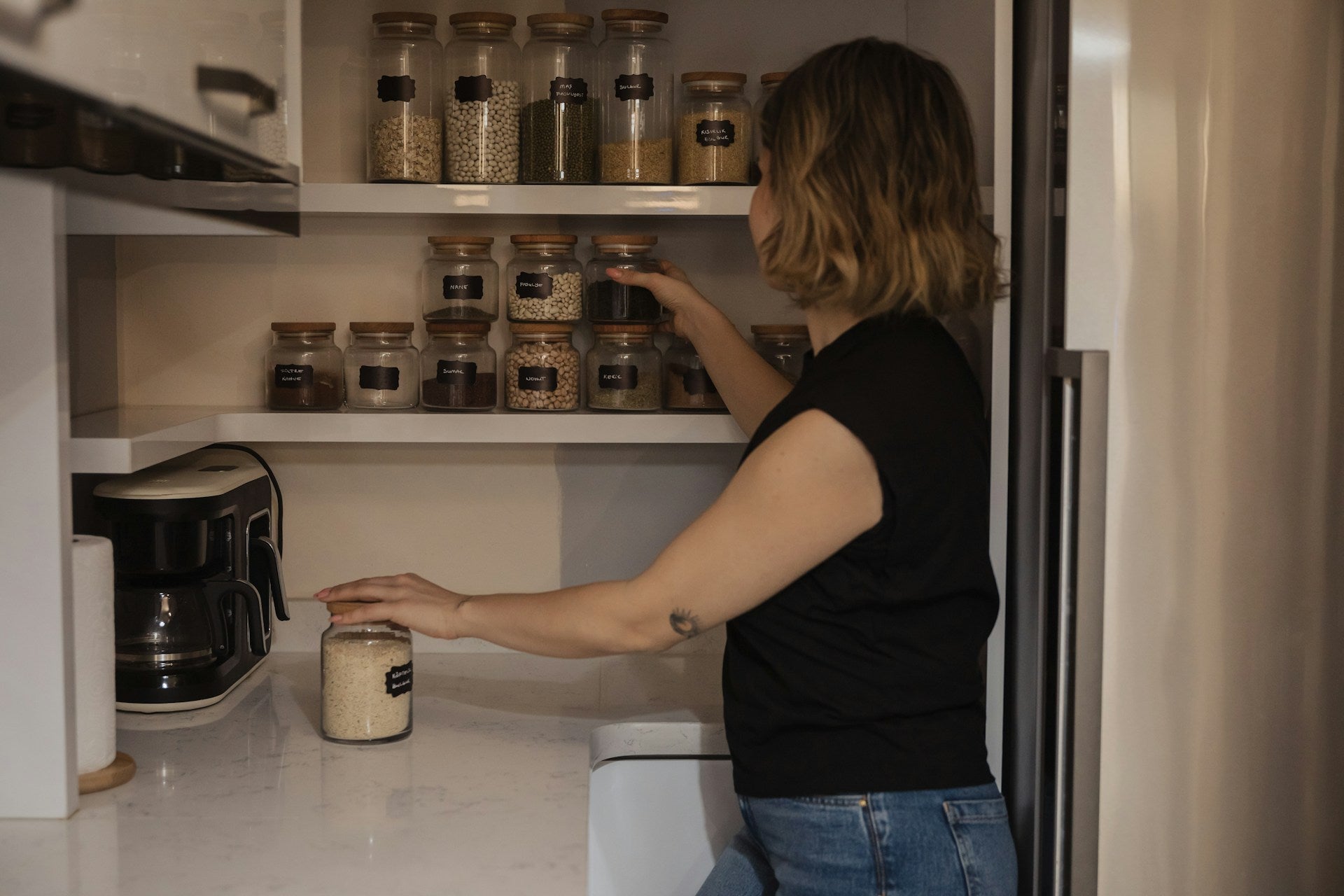
The Weight and Pleasure of an Honest Butler’s Pantry
A butler’s pantry should feel like it can take a hit. Heavy ceramic plates land with a flat, satisfying thud, thick glassware glides back into place, and open shelves carry the load without a creak or a shadow of movement. The pleasure comes from that mix of beauty and blunt utility, where every piece of storage earns its keep.
Too often, what we see instead are “look-but-don’t-touch” shelves. Boards bowing in the middle, spindly rod brackets telegraphing through the drywall, and that quiet anxiety that one more stack of plates might be the last. For a true working pantry, especially in design-forward homes, we build 1.75-inch-thick walnut floating shelves paired with the Hovr Bracket System (Classic) and a linear unlacquered brass gallery rail along the front edge. In the market of premium floating shelves in the USA, this kind of weight-bearing build is not an upgrade; it is the minimum standard for dense tableware that actually gets used every day.
Why Dense Tableware Demands True Weight-Bearing Floating Shelves
A real butler’s pantry is dense. Once you start stacking, the numbers add up quickly: dinner plates, salad plates, serving bowls, baking dishes, platters, cast iron, barware. A single run of shelving can quietly accumulate serious weight. That is exactly the kind of load that turns traditional 2-prong rod brackets into a problem.
Under that kind of daily use, those simple rods tend to:
- Sag slowly in the middle, even when they looked fine on day one
- Tilt the front edge of the shelf downward, so stacks want to creep forward
- Put ugly racking pressure on drywall and anchors instead of into the studs
- Create real safety concerns in a high-traffic kitchen where kids, guests, and hot dishes all move quickly
When we talk about weight-bearing floating shelves, we mean a shelf and hardware pairing engineered from the start to handle that kind of work. With the Hovr Bracket System (Classic), an 8-inch-deep shelf has an average capacity of about 300 pounds, and we treat that as a comfortable working range, not a marketing stretch. That’s industry-leading strength, about 13x-stronger than standard brackets, and it is what keeps your shelves feeling as solid on day one hundred as they did on day one. In a butler’s pantry, that kind of strength translates directly into confidence and safety. You should be able to drop a stack of stoneware onto the walnut, hear that satisfying low knock, and never feel the shelf twitch, whether it’s holding heavy dinnerware in the pantry or a full run of books and barware in a living space that sees daily traffic.
Anatomy of a Rock-Solid 1.75-Inch Walnut Pantry Shelf
The shelf itself is the other half of the equation. We work with solid American walnut, built up to a full 1.75 inches thick. That thickness gives us enough material to embed the Hovr female bracket in the back without weakening the board, and it gives your eye a satisfying, architectural line on the wall. We orient the grain so it reads in long, continuous sweeps, then select boards for figure so you get that dark, “rich chocolate” depth that suits a pantry’s lower, more intimate light.
The Hovr Bracket System is a male/female interlocking design in 6063-T6 aircraft-grade aluminum. The male section mounts across multiple studs, tying your shelf into the structure of the house instead of a few mystery anchors. Because the male bracket can span and catch studs wherever they fall, it solves the usual stud-placement constraints and lets you position shelves where they make sense visually and functionally, rather than where a pair of rods happen to land. The female section is let into a routed channel in the back of the walnut shelf. When you slide the shelf on, the two profiles interlock along the entire length. A set screw then pulls the shelf tight to the wall, turning the bracket and the walnut into a single, rigid unit with no sag and no wiggle.
For a typical butler’s pantry, we like 8 to 10 inches of depth for dinnerware. At those depths, the Classic Hovr bracket provides that roughly 300-pound average capacity and is roughly 13x-stronger than standard floating brackets that rely on a few rods. That kind of industry-leading strength is a genuine safety feature in busy households, whether the load is heavy stoneware, a massive book collection, or a row of bar bottles that live right at arm’s reach. The result is a shelf that feels like a solid piece of cabinetry, but visually reads as light and open. Finished in a natural oil or clear coat, walnut’s figure and end grain catch just enough light to glow against stone counters and painted cabinets without shouting for attention.
The Gallery Rail Kitchen Shelf: Brass, Safety, and Ceremony
Once the walnut and Hovr are in place, we finish the front with an unlacquered brass linear I-shaped rail. This detail is not only decorative. In a working pantry, a gallery rail kitchen shelf makes everyday movement feel safer and more deliberate.
Functionally, the rail does a few important things:
- Creates a low guard that keeps stacks of plates from creeping forward over time
- Stabilizes tall piles, oversized platters, or leaning coupe bowls
- Adds a tactile front edge to grab when you are loading or unloading heavy items
- Gives guests a subtle cue about where items belong along the shelf
Because the brass is unlacquered, it starts out bright and then gradually mellows as you handle it. Fingerprints, steam, and daily use darken the metal into a warm tone that plays beautifully against the dark walnut. This is the kind of “living” material combination that rewards daily use instead of hiding it.
From a joinery standpoint, the 1.75-inch thickness matters again. It gives us enough meat to mount the rail cleanly to the face, with layout that keeps fasteners away from the internal Hovr channel. We pay attention to spacing, alignment, and straightness so the rail does not visually wander, even over longer spans. The end result is a gallery rail kitchen shelf that feels intentional, protective, and a little ceremonial every time you set a stack of plates behind that brass line.
Designing a Butler’s Pantry Around Premium Floating Shelves in the USA
Once you know your shelves can actually carry the load, design becomes much more fun. A butler’s pantry works best when shelf heights and depths are tuned to how you entertain and cook. Instead of guessing, we like to think in terms of “zones.”
For most layouts, consider:
- Lower shelves: deeper and spaced for dinner plates, mixing bowls, and everyday stacks
- Mid shelves: slightly higher and perfect for serving bowls, platters, and barware
- Upper shelves: for lighter or seasonal pieces, where visual rhythm matters more than quick reach
- Appliance parking: a stretch of lower counter between shelf runs for stand mixers or espresso setups
On the wall side, stud mapping can make or break a floating shelf project. Traditional rod brackets force you to land supports at exact stud locations, which rarely match your ideal shelf layout. The Hovr male bracket solves that by running along the wall and catching multiple studs wherever they fall, so you can position your shelves where they make sense visually and functionally while still securing firmly into the structure. That ability to anchor into studs anywhere along the wall is a big part of why the system delivers such reliable, no-sag performance over time.
As you repeat 1.75-inch-thick walnut shelves with consistent rail height and tone, the pantry starts to feel like a quiet gallery of useful objects. Even a row of mixing bowls or everyday tumblers looks considered when the shelving itself is strong and consistent. In the broader field of premium floating shelves in the USA, that integration of structure, material, and layout is what separates a working pantry from a prop pantry.
From Wall to Heirloom: Installation Details That Make It Effortless
The last piece is how everything actually goes onto the wall. A rock-solid system still needs careful installation. We always start with a few non-negotiables: finding studs, checking the wall for flatness, and marking level lines for each Hovr male bracket. Once the bracket is anchored across multiple studs, we dry-fit the walnut shelf to confirm the interlock before tightening the set screw that pulls the shelf back into the wall.
For tricky butler’s pantry conditions, a bit of planning pays off:
- Corners: decide which run gets priority and keep shelf thickness consistent across both walls
- Inside returns: keep gallery rails aligned so the brass line “wraps” the corner cleanly
- Tile backsplashes: set bracket heights before tile, so the shelves appear to grow straight out of the finished wall
- Integrated lighting: coordinate wiring paths with bracket placement to avoid conflicts
The male/female interlocking design of the Hovr system is what eliminates that telltale wiggle that many floating shelves develop. When secured correctly, the shelf and bracket behave as one unit, resisting tilt and sag over time. A careful DIYer can often handle a straightforward install, especially on open, framed walls. For longer spans, uneven walls, or layouts involving corners and lighting, professional installers or designers can take that foundation and execute it with millwork-level precision.
Elevate Your Butler’s Pantry From Storage to Daily Ritual
In the end, the appeal of a well-built butler’s pantry comes down to feel. The sound of weighty plates landing on a no-sag walnut shelf, the soft clink of glass against brass, the stillness of a shelf that does not move even a fraction under a full run of stoneware or books, all of that turns simple storage into a small daily ritual. Heavy, honest objects on heavy, honest shelves.
When every item is on display and within reach, weight-bearing floating shelves need to feel as stable as a traditional cabinet, while keeping the room open and airy. A 1.75-inch-thick walnut shelf on a hidden Hovr Bracket System, paired with an unlacquered brass linear rail along the front edge, is our answer to that balance. With its industry-leading strength, about 13x-stronger than standard brackets and an average capacity of 300 pounds at 8 inches of depth, the Hovr system adds a layer of quiet safety to busy households, from heavy dinnerware in the pantry to massive book collections in a library wall. Measure your wall, take stock of your heaviest pieces, and let the structure of your shelving rise to meet the way you actually live and entertain.
Elevate Your Space With Thoughtfully Crafted Storage
Transform your walls into functional focal points with our handcrafted Premium floating shelves in the USA. At The Mortise & The Hare, we carefully select each piece of hardwood so your shelves look beautiful and perform reliably for years. If you are ready to bring custom-quality shelving into your home, reach out to our team through our contact page and we will help you plan the right solution for your space.
Share:
Fast-Track Your Kitchen: Trade Heavy Uppers for White Oak Shelves
Building a No‑Sag Home Library Wall That Lasts