



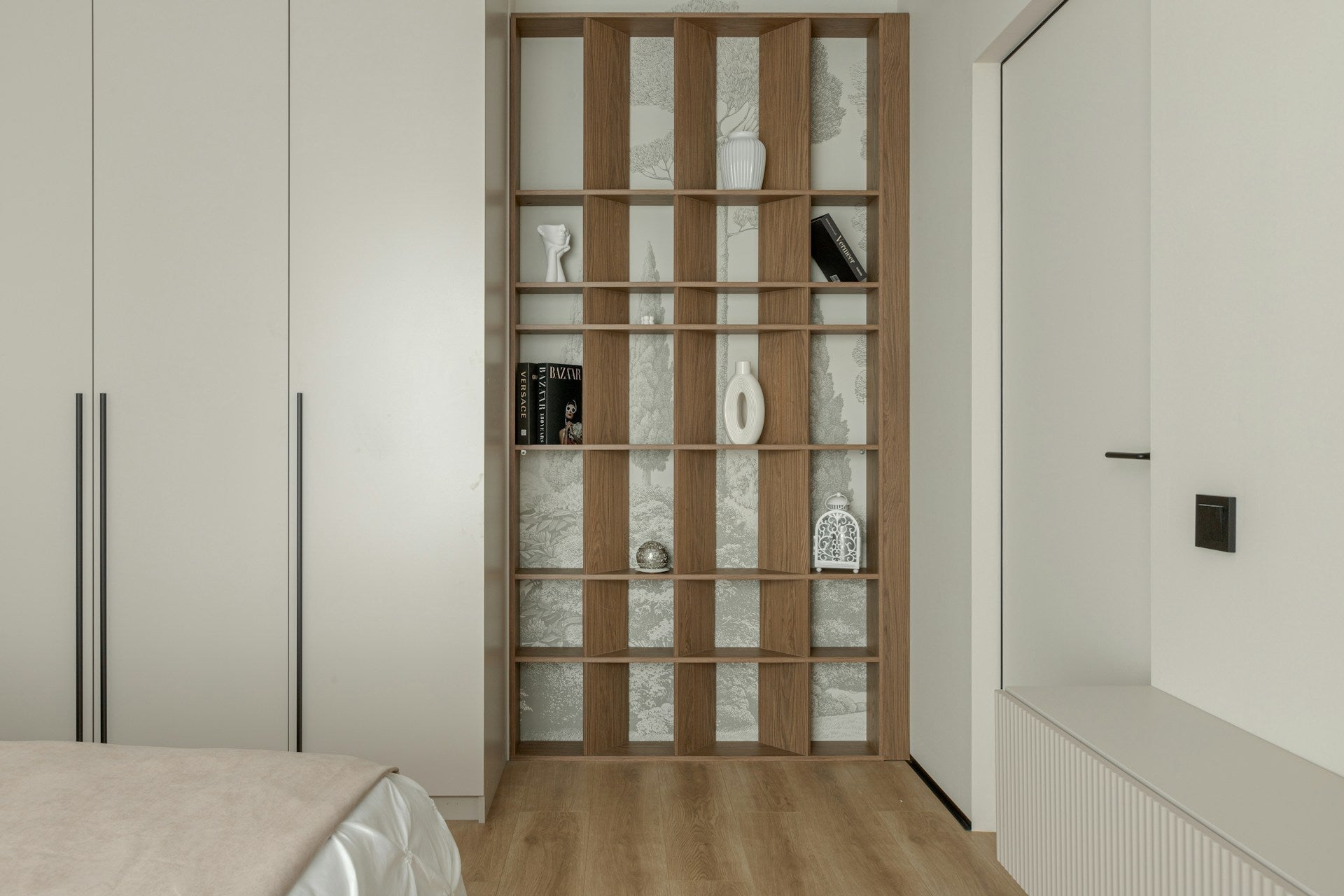
Custom-Depth Shelves That Actually Fit Your Space
Standard shelves almost always ask you to compromise. They are too deep for a narrow hallway, too shallow for dinner plates, or they stop an inch short of the wall you want to fill. You live with odd gaps, unsafe overhangs, or clutter that never quite feels settled.
A custom-depth wall shelf solves that. You choose the exact projection from the wall, so the shelf fits your room and your things instead of the other way around. For Japandi, Scandi, Minimalist, and Mid-Century Modern rooms, that precision matters, because these styles rely on calm lines, open space, and pieces that feel built in, not tacked on.
When we build solid hardwood floating shelves, we treat them like a mix of architecture and furniture. They look permanent, they feel sturdy, and they fade into the room in the best way. Late summer is a perfect time to plan them, as you get kitchens, living rooms, and baths ready for fall gatherings and that back-to-routine order everyone craves after a busy warm season.
Why Depth Matters in Japandi, Scandi, Minimalist, and MCM Rooms
Depth changes everything. If a shelf is too deep, it feels chunky and heavy on the wall. If it is too shallow, it looks stingy and will not hold what you need day to day.
For clean, simple spaces, we often think in depth ranges like these:
- About 7 to 8 inches in minimalist living rooms, enough for books and objects
- About 9 to 10 inches in Japandi style kitchens, to hold dinnerware and bowls comfortably
- About 5 to 6 inches in small Scandi bathrooms, so the wall still feels light and airy
- Around 9 to 11 inches in Mid-Century Modern spaces for large art books, records, and sculptural pieces
These numbers are not rules, but they are helpful starting points. The goal is balance. You want a shelf that feels in scale with the wall, the furniture below, and the things it will carry.
Depth is also a great tool for visual rhythm. When we size custom-depth shelves to line up with a door casing, window trim, or countertop, you get one calm, continuous line across the room. Your eye does not hit random steps and ledges. If you keep the same wood and finish from room to room, then adjust depth for each space, the whole home feels connected even as each wall does its own job.
Solid Hardwood vs. Veneers and MDF in Clean-Lined Spaces
Japandi, Scandi, Minimalist, and Mid-Century rooms ask for honest material. Simple lines leave nowhere to hide fake wood patterns or chipped corners. The shelf is right there at eye level, so it needs to be the real thing.
That is why we build in solid hardwood, not thin veneers over MDF. A veneer is only a skin. Once an edge chips or a corner swells, you are into the core and there is very little you can do. MDF cores are especially prone to swelling if they see moisture and can crumble around fasteners.
Solid hardwood gives you:
- Visible end grain that proves it is not just a printed picture on a surface
- Real figure and color that shift gently with the light
- Full-thickness material around hardware, so screws and brackets have something substantial to bite into
- The ability to refinish and repair instead of throwing it away when life leaves a mark
We work with American hardwoods like Walnut, White Oak, Maple, and Red Oak. Each one brings a different mood:
- White Oak brings warm Japandi and relaxed California casual energy
- Maple keeps things bright and crisp for classic Scandinavian lightness
- Walnut adds depth and contrast that fit Minimalist and Mid-Century rooms nicely
- Red Oak offers a familiar, grounded grain that can feel right at home in both traditional and modern spaces
Compared to veneers on MDF, solid hardwood also wins on structure. Veneer edges are thin and can fail around hardware. MDF is more likely to swell if it sees moisture. A full-thickness hardwood shelf gives the bracket more material to bite into, which means better long-term sag resistance and a shelf that keeps its line.
Building a Safer Floating Shelf with Hovr Brackets
A clean floating shelf needs strong, hidden hardware. For that, we pair our shelves with the Hovr Bracket System, made from 6063 T6 aircraft-grade aluminum. It is a male/female interlocking system that works very well in real use.
The system has two parts:
- The male bracket mounts to the wall, straddling studs so we can secure it into multiple studs anywhere along the wall, even when the studs are not exactly where you want the shelf.
- The female bracket is embedded in the shelf and slides over the male piece.
Once the shelf is in place, a small set screw locks the two together. This creates a rigid, no-sag connection. The Classic Hovr bracket averages about 300 pounds of capacity at an 8-inch depth. That is industry-leading strength, about 13x stronger than standard brackets that rely on two simple rods. Those traditional 2‑prong rod brackets tend to slant or nose-dive over time as the rods flex in the wall.
This strength is not just a spec, it is a safety feature. It means you can load stacks of plates, heavy cookbooks, or thick art books without worrying, even in busy households and high-traffic areas.
For different needs, you can choose between the Classic and Slim versions: Classic for heavy kitchen and library shelves or deep Mid-Century style record runs, Slim when you want a thinner profile on lighter, shallower shelves where the hardware should all but disappear.
How We Install Floating Shelves so They Stay Put
If you are installing shelves yourself, here is the basic approach we use in the shop and on site:
- Find and Mark Studs Use a good stud finder, then confirm by drilling a small test hole where the bracket will cover. Mark the centerline of each stud across the layout.
- Lay Out the Bracket Height Decide your finished shelf height, then mark a level line where the top of the wall (male) Hovr bracket will sit. A long spirit level or laser makes this much easier.
- Anchor the Male Bracket Pre-drill through the Hovr bracket into each stud along the run. Use high-quality structural screws sized for your wall type, into wood studs for full strength. Tighten all screws so the bracket pulls flat to the wall.
- Set the Female Bracket in the Shelf Our shelves come with the female Hovr bracket already embedded and aligned, but if you are doing it yourself, rout a straight, flat channel so the female piece sits flush. Secure it with the recommended screws along the full length.
- Test Fit and Level Slide the shelf (female) over the wall bracket (male). Check for level front-to-back and left-to-right. Fine-tune if needed before final tightening.
- Lock with the Set Screw Once everything is aligned, tighten the small set screw that ties the male and female brackets together. That interlock is what turns the system into a rigid, no-sag connection.
- Load Gradually Bring weight onto the shelf in stages: plates, books, then heavier pieces, just to confirm everything feels rock solid.
With the Hovr system straddling studs, you are not forced to compromise your shelf placement just because a stud is a few inches off from where you want the composition. The hardware gives us the freedom to design around your room, not your framing quirks.
Getting Custom Depth Right in Kitchens, Living Rooms, and Baths
In the kitchen, depth decisions are both visual and practical. Custom-depth wall shelves can line up perfectly with your countertops or tile edges so you do not get odd shadows or sharp corners sticking out. For everyday plates and bowls, depths around 9 to 10 inches usually feel good. For a small coffee station or spice area, a bit less depth can keep the wall open while still being useful.
You also want to plan:
- Enough headroom between shelves for tall glasses and serving pieces
- A clear strip above the counter for working space
- Space near range hoods so things do not crowd your cooking area
- In Mid-Century influenced kitchens, a little extra depth for wide platters, vintage ceramics, and larger glass canisters
Kitchens see grease and moisture, especially in humid regions. Solid hardwood with a quality hardwax oil can be cleaned and touched up as life happens, unlike coated MDF that can swell or chip.
In living rooms, shelf depth ties into mantels, built-ins, and media consoles. When we match those depths, the room reads as one clean composition instead of a mix of random parts. Deeper shelves, around 9 to 11 inches, work well for large art books and records in Mid-Century influenced spaces. Shallow shelves feel right for light Scandi vignettes with a few objects and lots of wall around them. Japandi living rooms often mix both: a deeper run near the sofa for books and bowls, and slimmer, higher shelves to keep the sightlines calm.
Bathrooms benefit from slimmer depths so shelves do not poke into tight spaces. You still need enough room for folded towels, jars, and small trays, but the shelf should sit back and let the room breathe. In a Minimalist or Japandi bath, a single, well-proportioned shelf in solid White Oak can be enough to hold daily essentials without cluttering the wall.
Humidity is a real factor in baths, so a solid hardwood shelf, properly finished and installed, is a smart pick where MDF often struggles over time.
Finishes and Details That Help Shelves Last for Decades
Touch matters as much as look. For Japandi, Scandi, Minimalist, and Mid-Century rooms, we lean toward hardwax oils like Rubio Monocoat or Osmo. These finishes bond with the wood fibers and leave a matte to soft satin surface that feels natural, not plastic. Scratches can often be spot-repaired without sanding the whole shelf.
Cheap polyurethanes tend to sit on top in a thick film, can amber in odd ways, and show wear more sharply. That is the opposite of the quiet, calm presence most people want from these styles.
Each wood species reacts a little differently:
- White Oak looks great in a natural or lightly toned oil that keeps the grain clear without pushing it too orange or too gray
- Maple usually benefits from a clear hardwax oil that keeps it light and clean for Scandi spaces
- Walnut and Red Oak do well with natural or gently warm oils that deepen the tone without getting shiny
Maintenance becomes simple. After a busy holiday season or a few years in a hard-working kitchen, you can wipe on a bit more oil to refresh the surface.
In the end, a custom-depth wall shelf should feel like it belongs to your architecture. When you choose the right depth for how you live, the right hardwood for your style, strong Hovr brackets for safety, and a finish that welcomes touch, you end up with something that can quietly serve your home for a long time. At The Mortise & The Hare, that is exactly how we like to build.
Transform Your Space With Thoughtfully Crafted Storage
If you are ready to add functional, beautiful shelving that fits your home perfectly, we can build a custom-depth wall shelf tailored to your exact needs. At The Mortise & The Hare, we design and craft each piece with long-term durability and responsible materials in mind. Share your ideas, measurements, or inspiration photos and we will help you turn them into a shelf that works beautifully in your space. If you have questions or want to start a quote, contact us today.
Share:
Ordering Custom Wood Shelves Online Without Sacrificing Fit
Ordering Custom Wood Shelves Online Without Sacrificing Fit