

- by Joseph Jenkins
Solid Wood Floating Shelves vs MDF or Veneer: An Honest Comparison
- 7 min read
- by Joseph Jenkins
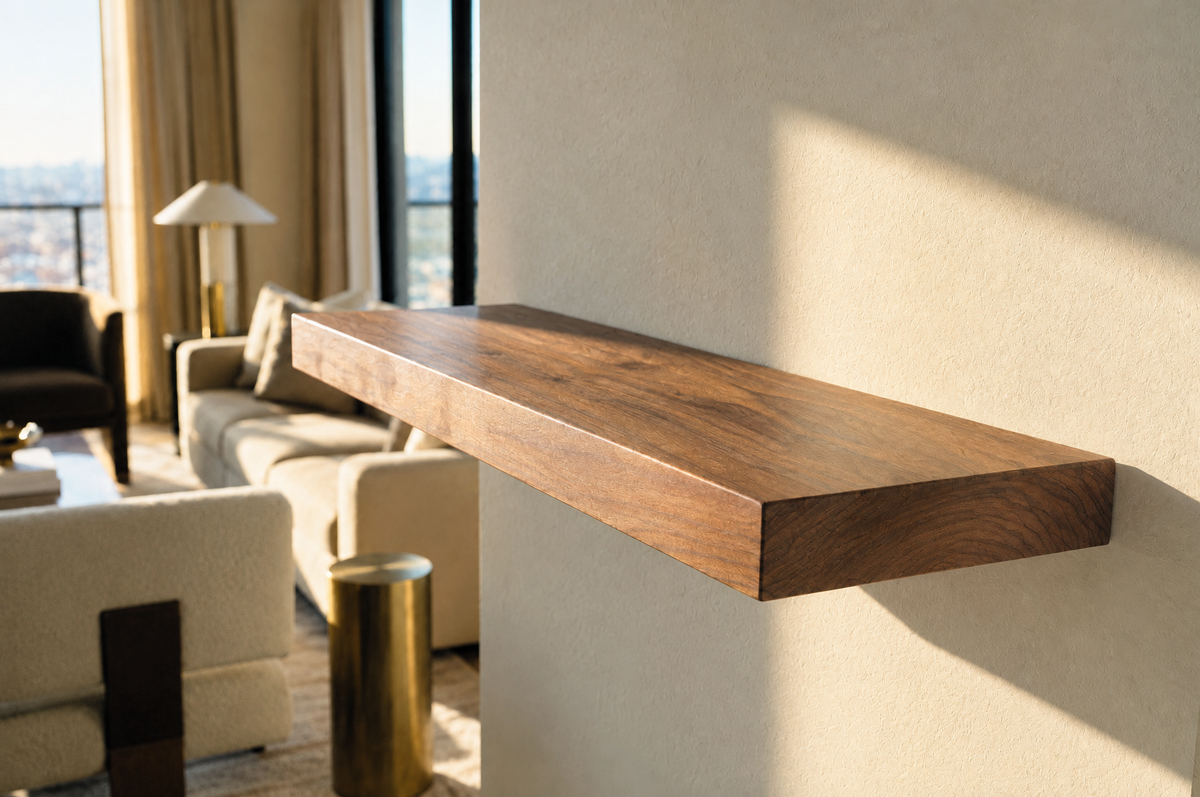
Short answer: If the shelf is carrying real weight, solid hardwood wins. It's stiff all the way through, it gives hidden hardware dense wood to bite, it takes dings without chipping, and you can sand and refinish it.
Veneered plywood is second. MDF is fine for light, painted shelves in a dry room. Hollow-core "honeycomb" boxes are the worst fit for heavy loads.
We only build in solid hardwood, so we're not neutral. That's why we tried hard to be fair below.
| Solid hardwood | Veneered plywood | MDF (painted or veneered) | Hollow-core / honeycomb | |
|---|---|---|---|---|
| What it is | One species, solid through the board | Thin wood face over cross-layered plies | Resin-bonded wood fibers pressed into sheets | Thin skins over a paper or cardboard grid, with a frame around the edge |
| Stiffness | High. Species-dependent and published (see below) | Good. Plies resist bending in both directions | Lower than solid hardwood at the same thickness | Depends on the skins and frame. Mostly air inside |
| Screw-holding | Excellent in face and edge | Good in the face, weaker in the edge | Fair in the face, poor in the edge. Weakens if screws are re-driven | Only where there's solid framing. Little or nothing in the core |
| Moisture | Moves seasonally. A good finish and kiln-drying keep it stable | Edges and face veneer can lift if water gets in | Swells at edges and screw holes, and generally doesn't recover | Skins can delaminate. Core can crush |
| Refinishing | Sand and refinish, more than once | Light scuff only. Veneer is thin | None. Repaint or replace | None. Repaint or replace |
| Edge damage | A ding is just wood, and it can be sanded | Chips can expose plies or edge banding | Corners crumble and chip | Dents can punch through the skin |
| Typical floating bracket | Routed full-length bracket (we use Hovr®) | Rods or routed hardware if thick enough | Rods, or surface brackets | Rods or an internal cleat inside the box |
People lump them together. They fail differently.
MDF is solid, just not wood. It's dense, flat, and uniform, which is why it paints so well. It's also heavy for its size. Its weak spots are edges, screw holes, and water.
An MDF floating shelf will carry light decor fine. Under steady load it bows sooner than solid hardwood of the same thickness, and it's holding your hardware with fiber, not grain.
Hollow-core is mostly air. Two thin skins glued over a honeycomb grid, with a solid frame around the edge. Light and cheap to ship, which is the point.
The problem is a bracket can only bite where there's solid material. So the load ends up on a narrow frame and a thin skin. That's why hollow shelves so often come rated for small loads, or with no rating at all.
"Not solid wood" covers a lot of ground. Ask which one it is.
"Solid hardwood" tells you the material. Grade tells you how good the boards are.
FAS ("Firsts and Seconds") is the top standard grade under the National Hardwood Lumber Association's rules. FAS boards are at least 6" wide and 8' long, and at least 83⅓% of the board has to yield clear cuttings. Fewer knots and defects means more predictable strength and cleaner grain on a long shelf.
Our homepage puts it this way: "We build exclusively with FAS-graded North American lumber that is kiln-dried for stability." Kiln-drying matters too. Wood that's brought to a stable moisture content before milling is a lot less likely to cup or twist once it's on your wall.
Hardness (the Janka number) tells you how well a surface resists dents. Good for floors and tabletops. It's not what keeps a shelf from sagging. Stiffness does that, measured as modulus of elasticity, or MOE.
Published numbers from the USDA Forest Products Laboratory's Wood Handbook (Chapter 5, average bending MOE at 12% moisture content):
| Species | MOE (million psi) |
|---|---|
| Northern red oak | 1.82 |
| White oak | 1.78 |
| Black walnut | 1.68 |
What that tells you:
These are averages for clear wood. Real boards vary, which is another reason grade matters.
How a shelf ages comes down to what happens when it gets scratched, ringed, or worn.
We finish by hand with zero-VOC finishes. Our 5" wood samples use a zero-VOC hardwax oil so you can feel the texture before you order.
Penetrating oils like hardwax oil can generally be refreshed in a worn spot without stripping the whole board. Film finishes like polyurethane usually need a full sand-back. If your shelf ever needs attention, email us and we'll tell you how to care for that finish.
Plainly: not every shelf needs solid hardwood.
Solid hardwood earns its price when the shelf carries real weight, lives in a kitchen or bath, needs to outlast a renovation or two, or is the piece people notice.
MDF and hollow shelves cost less up front. The bill shows up later, when they sag, swell, or chip and you replace them.
Solid hardwood costs more on day one, but you can refinish it, move it, and keep it. Our sustainability page notes that fast furniture tends to last a few years before it hits a landfill. We'd rather build one shelf you keep.
From our homepage: "We refuse to use veneers, MDF, or honeycomb fillers." Every shelf is FAS-graded North American hardwood, kiln-dried, then milled, planed, and finished by hand in our Long Island, NY studio. Never imported.
We mount it on the patented Hovr® aluminum bracket, which Hovr rates at about 300 lbs per shelf at 8" depth into studs. That pairing is what our Level for Life™ Guarantee is built on. We plant a tree through One Tree Planted for every shelf purchased, and every shelf ships in 3-4 weeks.
Not sure which species fits the room? Order a $4.99 hardwood sample first, or reach us at Info@themortiseandthehare.com or (516) 531-3949.
Browse our solid hardwood floating shelves. Every one is made to your dimensions. Never veneer, MDF, or honeycomb.
Share:
Why Floating Shelves Sag (And How to Choose Ones That Don't)