


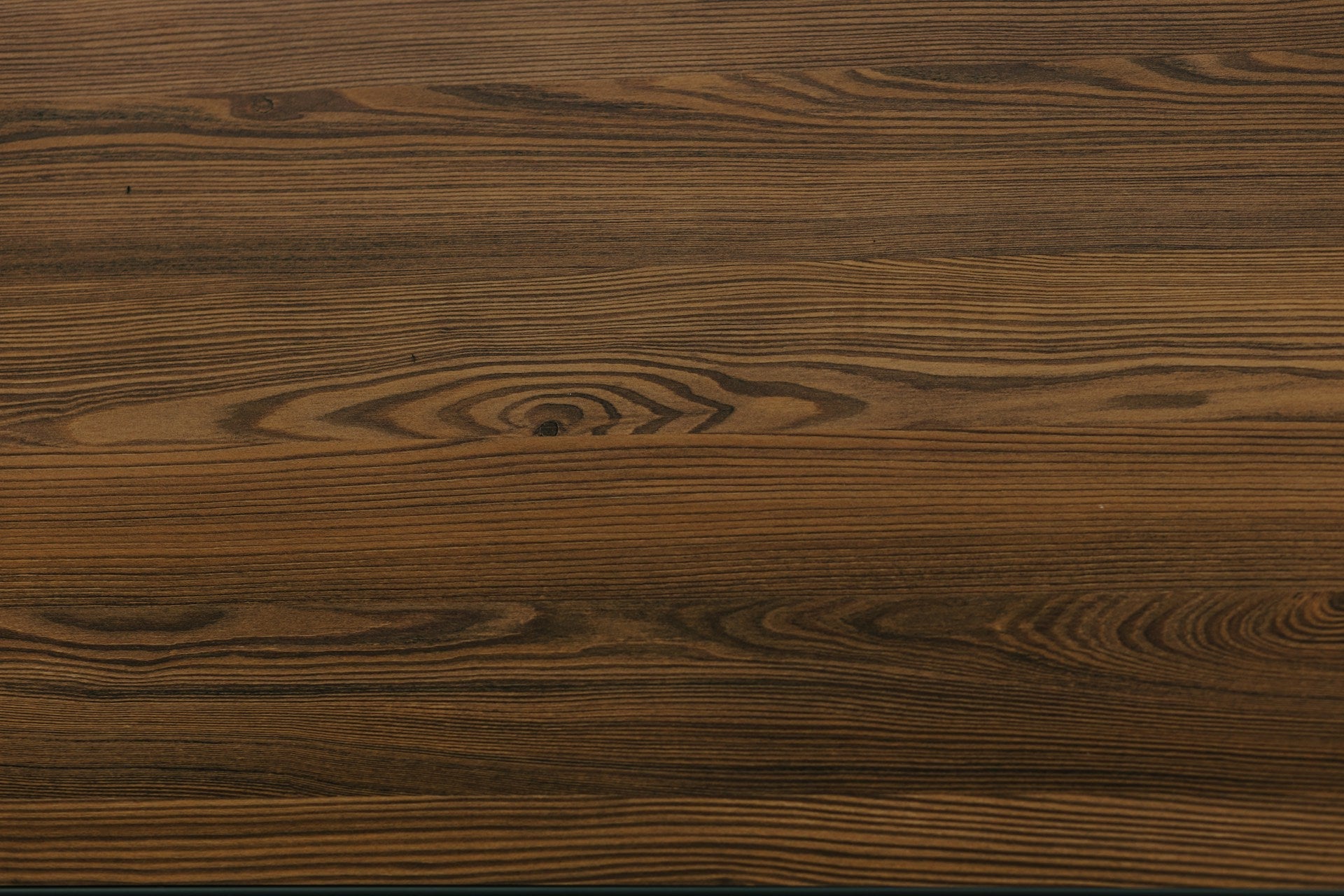
Why Your Shelves Deserve Better Than Fast Furniture
Shelves carry more than dishes and books. They carry the story of your home, in full view, every day. When they are built from the same MDF and plastic veneer as flat-pack consoles, they eventually tell a very different story: sags, chips, peeling edges, and that suspicious wobble under the weight of a real library.
At The Mortise & The Hare, we mill, join, and finish solid hardwood floating shelves for people who are tired of pretending that fast furniture is “high-performance.” We see the difference in the grain, in the screw holes, in the way a board feels under hand once it has been finished with a matte, open-pore oil like Rubio Monocoat Pure. By the end of this article, you will understand why real timber, properly supported, outperforms MDF in strength, longevity, and quiet everyday pleasure, and why premium floating shelves in the USA should not be built like disposable props.
MDF vs. Solid Hardwood: What “Performance” Really Means
Marketing departments love MDF. It is easy to describe as “stable,” “perfectly flat,” and “flawless,” at least under studio lighting. What the glossy copy rarely mentions is how it behaves once you introduce gravity, screws, humidity, and time. Performance in a real home is not about looking perfect on day one; it is about holding on day three thousand.
Here is what MDF actually is:
- Pulverized wood fibers mixed with resin
- Pressed into a uniform, fiberboard slab
- Skinned with veneer or laminate to fake grain and color
Because those fibers are short and held with glue, not continuous like real wood, MDF has weak screw-holding power. Fastener holes tend to:
- Crumble when stressed or over-tightened
- Lose grip with repeated loading and movement
- Swell and puff at exposed edges when exposed to moisture
Now compare that to solid hardwood. Real wood has:
- Continuous fibers that run along the length of the board
- Distinct end grain and growth rings that distribute load
- Natural density that gives screws and embedded brackets something substantial to bite into
When we install serious floating hardware into hardwood, those long fibers wrap around the threads and hold tight. Over time, as the wood gently compresses around the fastener, the connection often gets more secure, not less. With MDF, the same cycle tends to chew out the core.
Synthetic veneers over MDF try to pass as “perfect,” but they are a decor sticker over a fragile core. One bad chip at the front edge, one swollen patch near a dishwasher, and there is no honest, invisible repair. With solid hardwood, we can refinish, touch up, or even sand back a local area. The material underneath is as real as the surface.
The Tactile Truth: Why Matte, Open-Pore Finishes Feel Richer
Your hand can tell the difference between real timber and synthetic panels long before your eyes catch up. Run your fingers along a solid hardwood shelf finished in Rubio Monocoat Pure and you will feel the grain lines, the tiny shifts in density, the warmth that only comes from real wood. There is no plastic film separating you from the material.
Rubio Monocoat Pure does not sit on top as a thick coat. It:
- Bonds with the wood fibers in a single layer
- Penetrates the surface instead of forming a plastic shell
- Leaves the pores open so you can feel real texture
Because the finish lives inside the upper fibers instead of as a brittle layer on top, seasonal movement is not a problem. The wood can expand and contract slightly without causing peeling, cracking, or that cloudy look that film finishes can get over time. When life leaves a mark, we can spot-repair and refresh without stripping off a heavy coating.
Now compare that with the cold, uniform flatness of synthetic veneers and high-gloss panels. They have their own aesthetic, but they feel like what they are: flat, sealed, and a little lifeless. On frequently touched surfaces like floating shelves, that difference matters. In a kitchen, living room, or office, people instinctively read:
- Open-pore, matte texture as “real, crafted, and premium”
- Plastic-smooth panels as “cheap cabinet door turned sideways”
For premium floating shelves in the USA, the tactile experience is part of the value. Every time someone runs a hand along the front edge, the material quietly announces what you invested in.
Strength You Can Hang a Library on
Hardware is where the illusion of MDF “performance” really falls apart. Many standard floating shelf systems rely on simple rods or dowels that poke into the back of the shelf. That creates a series of point-loads, a lot of leverage, and a design that almost begs to sag over time, especially if the shelf core is MDF.
Common problems with those rod systems include:
- Sagging under heavy books or dinnerware
- Wall-side failure when screws loosen in drywall or mushy board
- Shelf-side blowouts where the rod tears the core internally
We pair solid hardwood shelves with the Hovr Bracket System, a 6063 T6 aircraft-grade aluminum male/female interlocking system. The male bracket mounts on the wall and can straddle multiple studs anywhere along the span, solving the old “stud is in the wrong place” problem. The female bracket is embedded inside the shelf. When you slide the shelf on, the two profiles lock together and are secured with a set screw.
The result is a rigid, No-Sag connection that does not rely on two lonely rods to hold everything up. The Classic Hovr bracket, at an 8-inch shelf depth, has an average load capacity of 300 pounds, which is about 13 times stronger than standard floating brackets. That is not a theoretical number for photo shoots; that is practical safety for:
- Heavy dinnerware and cookware stacks
- Serious book collections, not just a handful of coffee table titles
- Busy households where kids pull themselves up by the front edge
Solid hardwood is the other half of that equation. The dense, continuous fibers give the screws and embedded bracket serious bite. Over years of loading and unloading, the structure holds, instead of crumbling.
Design Without Compromise
There is a particular strain of minimalism that treats homes like empty product galleries: endless flat beige panels, everything flush, everything smoothed into anonymity. It photographs neatly, but in person it can feel more like a storage facility than a place where people live.
Solid hardwood floating shelves are a quiet way out of that. They bring:
- Warmth from real grain and tone
- Subtle variation from board to board
- A sense of material honesty in otherwise clean, modern rooms
Because we build to custom dimensions, we can match real spaces instead of forcing your walls to conform to off-the-shelf lengths. That means:
- Lengths that align with tile terminations or window casings
- Thickness and depth balanced to your cabinetry and ceiling height
- Thoughtful orientation of grain and figure across long runs
Designers tend to notice the details: clean end grain, continuous grain flow around a corner, tight joinery at returns. When the material is real, those choices read as intention, not accident.
As a long-term design choice, premium floating shelves in the USA built from solid hardwood age with the room. Rubio Monocoat Pure deepens into a gentle patina, small dents can be eased and re-oiled locally, and the color stays believable because it is sitting on actual timber, not printed paper. When MDF swells or a veneer edge chips, by contrast, the entire unit often jumps straight to “replace,” because there is very little that can be gracefully repaired.
Choosing Premium Floating Shelves in the USA with Confidence
If you want to see past the sales copy, start by asking a few blunt questions:
- What is the core material, solid hardwood or MDF?
- How does the shelf mount, interlocking continuous bracket or rods?
- What type of finish is used, penetrating oil or thick surface film?
Whenever possible, handle samples. Your hand will pick out the open-pore, matte feel of oiled wood vs. the sealed slickness of laminate instantly. For homeowners, think ahead about how you will use the shelves: rows of books, a wall of ceramics, glassware, or a mix of display and daily reach items. Match bracket capacity and shelf dimensions to those real loads, not just to a styled inspiration shot.
For interior designers, consider how species, color, and thickness relate to the rest of your palette. Solid hardwood shelves can echo flooring, tie in with beams, or provide a warmer counterpoint to painted cabinetry and stone. The goal is not to shout, but to let one honest material quietly ground the entire composition.
At The Mortise & The Hare, we build solid hardwood floating shelves, finish them in Rubio Monocoat Pure for that rich, open-pore feel, and mount them on 6063 T6 aircraft-grade aluminum Hovr Brackets for industry-leading strength. We are not chasing trends; we are building shelves meant to survive them, carrying your books, pottery, and memories without sagging, peeling, or pretending to be something they are not.
Get Started With Your Project Today
Transform your space with our handcrafted premium floating shelves in the USA, designed to bring lasting function and character to your home. At The Mortise & The Hare, we work closely with you to match the right size, finish, and style for your project. If you have questions about measurements, installation, or custom options, simply contact us and we will help you plan the perfect shelving solution.
Share:
Floating Shelf Micro-Details: Edge Profiles, Shadow Gaps, and Hidden Hardware
Fast-Track Your Kitchen: Trade Heavy Uppers for White Oak Shelves