



A floating shelf can hold heavy things. It can also sag, roll forward, or come off the wall if the rating leaves out the studs, the depth, or the shelf itself. If you are planning a wall of books, dishes, or other real storage, the questions are practical. Can it hold the load? Do you need studs? How do you keep it from sagging?
Short answer: Yes, a floating shelf can hold heavy items when the whole chain is right. Our 1.75 inch and thicker solid hardwood shelves, on HOVR's patented hidden bracket, hold up to 300 lb of static load at 8 inches of depth into wood studs or structural blocking, and that number includes the shelf. Slim 1.5 inch shelves are rated 125 lb and are not covered by the Level for Life™ Guarantee.

Yes, when the board, the hidden bracket, the depth, and the wall connection all match the load. Eligible 1.75 inch and thicker shelves hold up to 300 lb static at 8 inches into wood studs, shelf included, under the Level for Life™ Guarantee.
Every shelf in our hardwood shelving collection is FAS-grade solid hardwood, milled and hand-finished in our Long Island shop, made to order, and built on HOVR's patented hidden bracket. There is no veneer, no MDF, and no honeycomb filler in the board. White oak stays quiet in a bright room. Walnut reads warmer and darker. The species is a room choice. The thickness, the bracket, and the studs are what hold the load.
It depends on the whole assembly, not a single headline number. Slim 1.5 inch shelves are rated 125 lb into studs and are not covered by the Level for Life™ Guarantee. Eligible 1.75 inch and thicker shelves hold up to 300 lb static at 8 inches of depth into wood studs or structural blocking, including the shelf, when installed as required. Mini Trio shelves use a different cleat, are not rated 300 lb, and are also outside the guarantee. They are not meant for heavy storage.
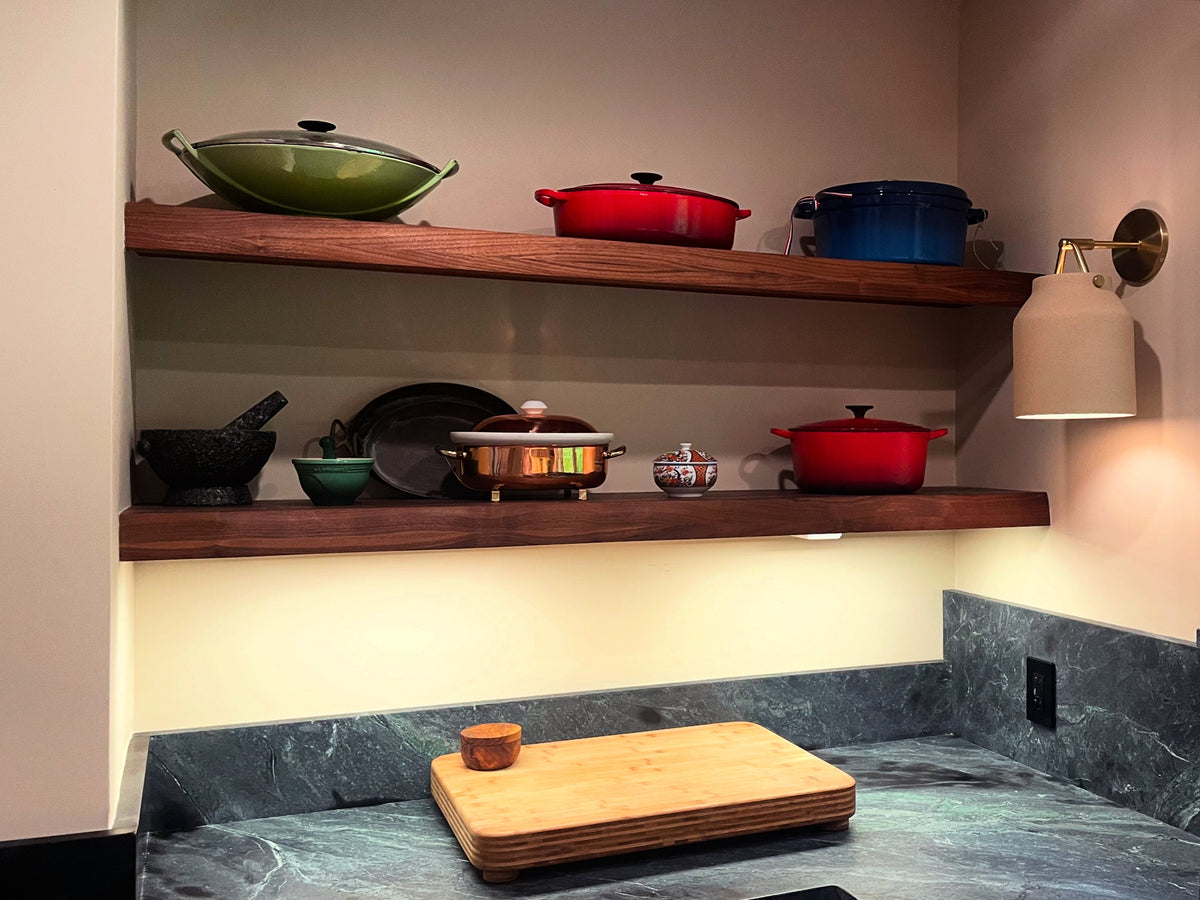
The solid walnut floating shelf is one finished example of the 1.75 inch build. For the longer explanation of how to read a rating, see our weight ratings guide. Deeper shelves increase leverage. Ask us before you order a deep shelf for a heavy load. We will not invent a number for 10 or 12 inches.
Yes. 100 lb of static load sits inside both of our published ratings when the shelf is installed into wood studs as required. Stay with the 1.75 inch and thicker profile for heavier storage, and count the shelf's own weight inside the 300 lb limit. 100 pounds is not a trick question. It is a bathroom scale and an honest install.
Yes, if you want the published rating or the Level for Life™ Guarantee. The wall bracket needs to be fastened into at least two wood studs or structural blocking. Drywall alone is not a rated connection.
We sell Quick Channel toggle anchors for odd walls, but they are not a substitute for studs under a heavy load, and we do not publish a drywall-only capacity. Tile or masonry can sometimes be adapted, still without a published rating for those walls. If you cannot reach wood studs or blocking, ask us before you order.
The full steps live in our floating shelf install guide. Plan on two studs, use the hardware that ships with the shelf, and lock the brackets with the provided set screws and epoxy when you want the guarantee to apply.
Fix all four links: a hidden bracket that can take the load, a thick solid-hardwood board, screws into wood studs or blocking, and a static load inside the published rating at that depth. Qualifying 1.75 inch and thicker shelves are covered by the Level for Life™ Guarantee if they sag under that rated load when installed as required.
Solid hardwood can still flex a little, but a thick board on a full-length hidden bracket, screwed into studs, is built not to droop under its rated static load. Hollow or fiberboard shelves are a different story. See our Journal on solid wood versus MDF or veneer floating shelves.
For why boards dip even when brackets hold, see our Journal on why floating shelves sag. That live guide covers bracket sag versus board sag, Slim versus Classic, and a simple level check. This page will not redo it.
We build on HOVR's patented hidden bracket, an interlocking aluminum cleat routed into the shelf. Classic is the heavy-load profile behind our 300 lb rating at 8 inches, into studs, on 1.75 inch and thicker shelves. Slim is for thinner 1.5 inch shelves at 125 lb. The bracket, the board, and the studs have to work together.
HOVR makes the bracket. We do not. We mill the solid hardwood shelf around that hardware, route the channel, and pick Slim or Classic for your load. For a closer look at the connection, see our guide to HOVR bracket floating shelves.

Start with a published rating that names the depth, the wall, and the load type. Choose solid hardwood thick enough for the job, usually 1.75 inches or thicker, on HOVR's patented hidden bracket, cut to your wall. Plan the install into studs. If the weigh-in is over the rating, split the load or pick a different kind of storage. Our guide to choosing solid wood floating shelves walks the broader decision.
For an open kitchen and everyday dishes, use our room guide to open kitchen shelves for heavy dishes. For a wall of books, plan on that same 1.75 inch or thicker build, and weigh a foot of your actual books instead of trusting a chart. If one shelf cannot take the weigh-in, use two shelves or a bookcase. Our Journal on floating shelves for home libraries is the place for that room.
A gallery rail does not raise the weight rating. It is a low metal rail along the front edge of the shelf that keeps cookbooks, dishes, and bottles from sliding off. Shop gallery rail shelving if that is the look you want. The rail belongs at the front, not the back.


We sell floating shelves. Sometimes we will still tell you not to buy one. A floating shelf with HOVR's patented hidden bracket is the right tool when the load is static, the depth is in range, and the bracket can go into wood studs or blocking. Very deep, very heavy storage, climbing loads, or a wall you cannot fasten into is a job for a different piece of furniture.
We do not publish a microwave rating. A microwave can be a point load, and a running appliance is not the same as a still stack of dishes. Email us the model, the weight, and the shelf depth before you plan that wall. If it is not a good floating-shelf job, we will say so.
We do not publish a houseplant rating. Wet soil, a dense pot, and a load out at the front edge are not the same as a still row of books. Weigh the pot as it will be used, keep heavy pieces toward the wall, and ask us before you order.
Capacity is a chain, not a sum. The published figure depends on bracket rating, shelf depth, wall fastening, and board stiffness. Our 300 lb figure is a static, per-shelf rating at 8 inches into studs, and it includes the shelf. More studs make a safer install. They do not multiply the rating. A 48 inch shelf on three studs is a better install than on two, but it is not a 450 lb shelf. We also recommend a safety-first 150 lb per stud connection, which is installation guidance, not permission to exceed the per-shelf rating.
Depth is leverage. Weight at the front of a deep shelf pries on the wall connection. Static means sitting still. Books or dishes at rest are a static load. Sitting, climbing, hanging, or dropping something on the shelf is not.
The honest way to size the load is to weigh what you actually own. Step on a bathroom scale and note your weight. Step on again holding one foot of books, or one stack of plates, and note it. Subtract. Multiply by the number of feet or stacks going on the shelf. Add the shelf itself. Ask us for the shelf weight of a selected build.
Records are one case where a published range helps you sanity-check a bad chart. Wikipedia's phonograph record entry puts a 12 inch LP at roughly 80 to 200 grams, about 0.2 to 0.4 lb, with 180 g called the ideal heavy pressing. So 100 LPs is roughly 18 to 44 lb of vinyl before jackets, sleeves, and box sets. If a guide assumes a pound or two per record, be skeptical. A rating that leaves out the studs, the depth, or the shelf itself is not a rating. It is a hope.
Ready to plan a shelf that can take the load? Shop solid hardwood floating shelves, cut to your size in our Long Island shop. Order a sample first if you want to see the wood in your light.
Share:
Q3 Shareholder Update: Dividends Paid in Oxygen
Why Floating Shelves Sag (And How to Choose Ones That Don't)